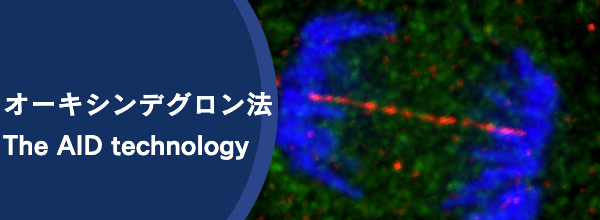
We focused on the fact that the plant hormone auxin induces the degradation of specific transcriptional repressors within plant cells, and by transferring this degradation pathway into heterologous eukaryotic systems, we established the Auxin-Inducible Degron (AID) method. With this technology, simply adding auxin to the culture medium enables degradation of proteins fused to the AID degron, with a half-life of less than 30 minutes. This method is already widely used in yeast research, where protein tagging is straightforward, and our laboratory is advancing its application to mammalian cells.


Rapid and direct degradation of target proteins
Auxin refers to a group of compounds such as IAA (indole-3-acetic acid) and NAA (naphthaleneacetic acid), which induce the degradation of a family of transcriptional repressors known as AUX/IAA proteins in plant cells. In this process, the required ubiquitin ligase complex SCF–TIR1 is activated when auxin binds to its TIR1 subunit. Noting that SCF subunits other than TIR1 are conserved across all eukaryotes, we can introduce an auxin-dependent degradation system by expressing TIR1 in yeast or mammalian cells. In these cells, degradation can be induced in the presence of auxin by fusing the target protein to a degradation tag (AID degron) derived from AUX/IAA proteins.


Introducing AID tags into endogenous genes in human cells
Until recently, adding tags directly to endogenous genes in human cells was extremely challenging. However, the advent of CRISPR-Cas9–based genome editing in 2013 dramatically changed the situation. While exploring methods to tag endogenous genes using CRISPR-Cas9, we developed a new technique that enables tagging without the need for laborious cloning procedures. This method allows the rapid introduction of AID tags into both alleles of a target gene in cultured human cells.
Controlling the expression of essential factors in human cells
We have established a technique to generate human AID-mutant cells using CRISPR-Cas9 genome editing. In these cells, the addition of auxin induces protein degradation with a half-life of approximately 20 minutes. This technology makes it possible to analyze the function of essential genes—estimated to comprise about 9% of human genes—that cannot be knocked out. We aim to apply this method to mouse ES cells and human iPS cells in the future.
Materials Request for the AID System
Plasmid materials for human cells
Published materials for use in human cultured cells are available from Addgene and NBRP. The HCT116 CMV-OsTIR1 parental cell line can be obtained from the RIKEN Cell Bank. For the HCT116 Tet-OsTIR1 cell line, please contact the same cell bank directly (cellkitaku@brc.riken.jp).
Plasmids and strains for budding yeast
Published materials for budding yeast are available from NBRP-Yeast. For information on generating yeast strains, please refer to this protocol.
 研究内容
研究内容